


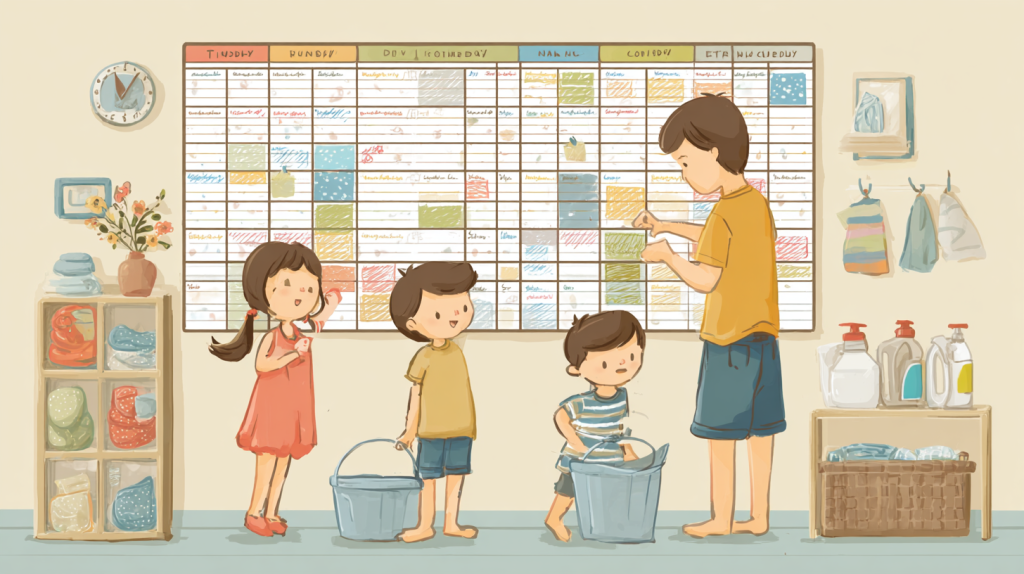
Every parent has tried some version of a chore chart at least once. You make a nice-looking chart, stick it on the fridge, explain the rules, and for about four days everyone is on board. By day five, nobody remembers it exists. The chart collects dust, the dishes pile up, and you end up doing everything yourself again while quietly resenting the fact that nobody in your house seems to notice when the trash is full.
The problem usually isn’t the kids. It’s the system. Most chore charts fail because they’re either too complicated, too vague, or there’s no meaningful follow-through attached to them. A chart that actually works for longer than a week needs to be simple, age-appropriate, and tied to something the kid actually cares about. Here’s how to set one up that sticks.
Start With Age-Appropriate Tasks
The biggest mistake parents make is assigning chores that are either too easy (so the kid gets bored) or too hard (so the kid gets frustrated and gives up). What a three-year-old can handle is very different from what a ten-year-old should be doing, and the chart needs to reflect that.
For toddlers and preschoolers, ages two to four, keep it extremely basic. Putting toys back in a bin, placing dirty clothes in a hamper, helping wipe up small spills with a towel, and feeding a pet with supervision are all reasonable. These aren’t really about getting the house clean. They’re about building the habit of contributing. At this age, kids actually want to help. They think chores are fun because they’re imitating what they see adults do. Lean into that while it lasts.
Kids ages five to seven can handle more responsibility. Making their bed (it won’t be perfect, and that’s fine), setting the table, clearing their dishes after meals, watering plants, sorting laundry by color, and tidying their room are all fair game. The key is that these tasks should be completable without constant adult intervention. If you have to stand over them and direct every step, the task is too complex for their age.
From eight to twelve, kids can take on real household contributions. Unloading the dishwasher, vacuuming, sweeping, taking out the trash, folding and putting away their own laundry, cleaning bathrooms with supervision, and helping with meal prep all work. These are the years where chores start to genuinely lighten the household load, and also where resistance tends to increase. That’s normal and manageable with the right structure.
Teenagers can handle essentially any household task an adult can do. Cooking simple meals, mowing the lawn, doing their own laundry from start to finish, cleaning the kitchen after dinner, and watching younger siblings are all appropriate. The challenge with teens is less about capability and more about motivation, which is where the incentive structure matters.
Keep the Chart Simple and Visual
A chore chart that requires a manual to understand is a chore chart nobody will use. The best format depends on your kids’ ages, but the principle is the same: it should be immediately obvious what needs to be done, who does it, and whether it’s been completed.
For younger kids, use pictures or icons instead of text. A drawing of a bed means make your bed. A drawing of a dog bowl means feed the dog. Pair each task with a sticker or checkmark system so the kid gets a small visual reward every time they complete something. Young children are extremely motivated by stickers. It sounds almost too simple, but it works because it gives them an immediate sense of accomplishment.
For older kids, a basic grid works fine. Names down the left side, days of the week across the top, and tasks listed in each cell. You can use a whiteboard, a printed sheet, or even a shared app if your family is more tech-oriented. The goal is that everyone can see at a glance what they’re responsible for each day. Put it somewhere visible like the kitchen or a hallway, not buried in a drawer or hidden on the side of the fridge behind magnets.
Rotating chores weekly helps prevent the “I always have to do the worst one” complaints. If taking out the trash and cleaning the bathroom switch between siblings every week, nobody feels permanently stuck with the least desirable job. It also teaches kids to handle different types of tasks instead of just getting good at one thing.
Be Specific About What “Done” Means
“Clean your room” is the vaguest possible instruction and it’s the reason so many chore battles happen. Your definition of a clean room and your eight-year-old’s definition are wildly different. To you, it means the floor is clear, the bed is made, clothes are put away, and the desk is organized. To them, it means shoving everything under the bed and calling it good.
Define each chore clearly. Instead of “clean your room,” break it into specifics: “put dirty clothes in the hamper, put toys in the bin, make the bed, and clear off the desk.” Instead of “do the dishes,” say “load the dishwasher, wipe down the counters, and put the dish soap away.” When the expectation is crystal clear, there’s no room for the “but I did clean it” argument. The kid either completed the specific steps or they didn’t.
For younger kids, you can walk through the steps together the first few times until the routine is learned. For older kids, a simple checklist taped inside a cabinet door works great. Once they’ve done it correctly a dozen times, the checklist becomes unnecessary because the habit is built.
Tie It to Something That Matters
A chore chart without consequences or rewards is a suggestion, not a system. You need some kind of follow-through mechanism, and what works depends on your family’s approach to motivation.
Allowance tied to chores is the most common approach. The kid earns a set amount of money each week for completing their tasks. If tasks are skipped, the pay is reduced proportionally. This teaches both responsibility and basic financial concepts. Some families set a base allowance for “expected” chores and then offer bonus earnings for extra tasks like washing the car or organizing the garage. That creates an opportunity for kids who want to earn more.
If you’d rather not use money, a points or token system works too. Each completed chore earns a point, and points can be redeemed for privileges like extra screen time, a movie night pick, a later bedtime on weekends, or a special outing. The key is that the rewards need to be things the kid genuinely values. If your twelve-year-old doesn’t care about picking a movie, that’s not a motivator.
Some families skip rewards entirely and frame chores as a non-negotiable part of being in the household. Everyone contributes because that’s how a family works. This approach can be effective, but it requires very consistent enforcement. If chores don’t get done, a specific privilege gets removed. Screen time, hanging out with friends, or whatever matters most to that particular kid. The consequence needs to be immediate and directly connected to the missed responsibility, not a vague threat that never materializes.
Whatever system you pick, be consistent with it. The number one reason chore charts fail is that parents enforce the system enthusiastically for the first week and then gradually stop tracking. Kids notice that instantly. If completing chores doesn’t reliably lead to the promised outcome, the whole thing collapses.
Expect Imperfection and Adjust
Your five-year-old’s made bed is going to look like a lumpy mess. Your eight-year-old is going to miss spots when sweeping the floor. Your teenager is going to load the dishwasher in a way that makes no logical sense. Let it go. If you redo their work every time or criticize the quality constantly, they learn that there’s no point in trying because it’s never good enough.
The standard for kids’ chores is “completed with reasonable effort,” not “done to adult standards.” As they get older and more practiced, the quality will naturally improve. For now, the goal is building the habit of doing the work, not perfection.
Revisit and adjust the chart every couple of months. As kids age, their abilities change and so does the household’s needs. Tasks that were challenging six months ago might now be too easy, and new responsibilities can be introduced. Check in with your kids about how the system is working. If a particular chore consistently causes conflict, figure out why. Maybe it’s genuinely too hard, or maybe the timing doesn’t work with their schedule. Small tweaks keep the system functional and prevent it from becoming a daily battle.
Make It a Family Thing
The chore chart works better when it’s not something imposed from above, but something the whole family buys into. Let kids have a say in which chores they prefer. Give them a choice between two or three options rather than dictating every task. When kids feel like they had input in the system, they’re more likely to follow through.
It also helps when parents are visibly doing their own chores alongside the kids. If you’re asking your ten-year-old to clean the bathroom while you sit on the couch scrolling your phone, expect pushback. But if the whole family spends 20 minutes on Saturday morning doing a quick house reset together, it feels less like punishment and more like a team effort. Put on some music, set a timer, and make it a shared activity rather than an individual assignment. The faster everyone works, the faster everyone gets back to doing what they actually want to do.